
Accredited by the National Board of Accreditation (NBA) under Tier-I
The Department of Information Technology at Vardhaman College of Engineering organizes a wide range of academic, technical, professional, and extracurricular activities to support holistic student development. Through professional bodies such as IEEE, ISTE, ACM, and TAIT, the department conducts workshops, expert lectures, industrial visits, seminars, faculty development programs, and national-level training sessions focused on emerging technologies and career readiness. Along with technical initiatives, the department also promotes participation in games, cultural activities, NCC, and NSS to foster leadership, teamwork, and social responsibility, thereby bridging the gap between academic learning and industry expectations.
The Department of Information Technology actively nurtures a culture of professional growth, research orientation, and technological excellence through its vibrant student chapters and technical associations. These bodies serve as platforms for students to gain global exposure, develop interdisciplinary skills, and stay aligned with emerging advancements in Information Technology.
The IEEE Information Theory Society (IT) is a premier professional society dedicated to advancing the mathematical foundations of information technology for the benefit of humanity. Information theory encompasses the processing, transmission, storage, and utilization of information, forming the theoretical basis of modern communication systems.
The IT Chapter actively organizes:
The IEEE Engineering in Medicine and Biology Society (EMBS) is one of the largest international societies of IEEE that focuses on the application of engineering principles to medicine, biology, and healthcare. It provides IT students with opportunities to apply information technology, artificial intelligence, and data science in healthcare and biomedical applications.
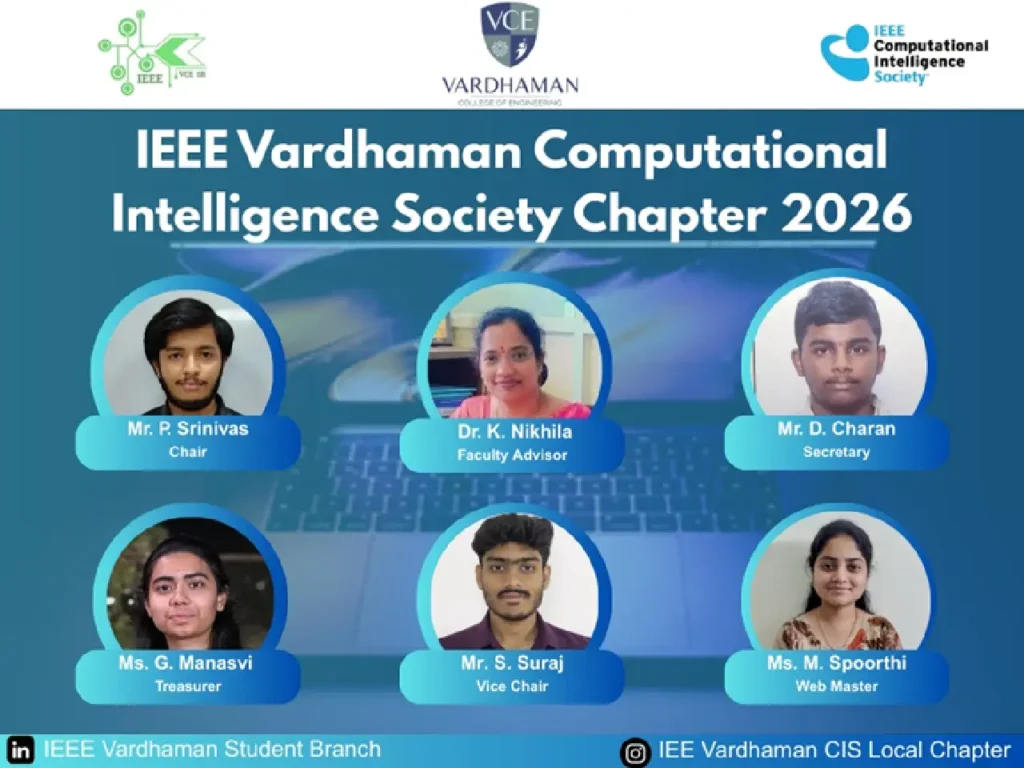
The IEEE Computational Intelligence Society (CIS) focuses on the theory, design, application, and development of nature- and brain-inspired computational paradigms, including neural networks, evolutionary computation, swarm intelligence, fuzzy and rule-based systems, cognitive systems, and learning-based artificial intelligence. These paradigms form the foundation of modern intelligent systems that address complex, nonlinear, and uncertain real-world problems. The IEEE Computational Intelligence Society (CIS) aims to foster innovation and research in intelligent systems and computational technologies. It provides a platform for students to explore areas like artificial intelligence, neural networks, fuzzy systems, and evolutionary computation.
The Indian Society for Technical Education (ISTE) is a national-level professional organization established to promote quality and excellence in technical education in India. Founded in 1941, ISTE works towards improving teaching–learning processes, curriculum development, industry interaction, research culture, and professional ethics among engineering and technical institutions. ISTE serves as a strong platform for faculty members, students, and institutions to enhance their academic and professional competencies.
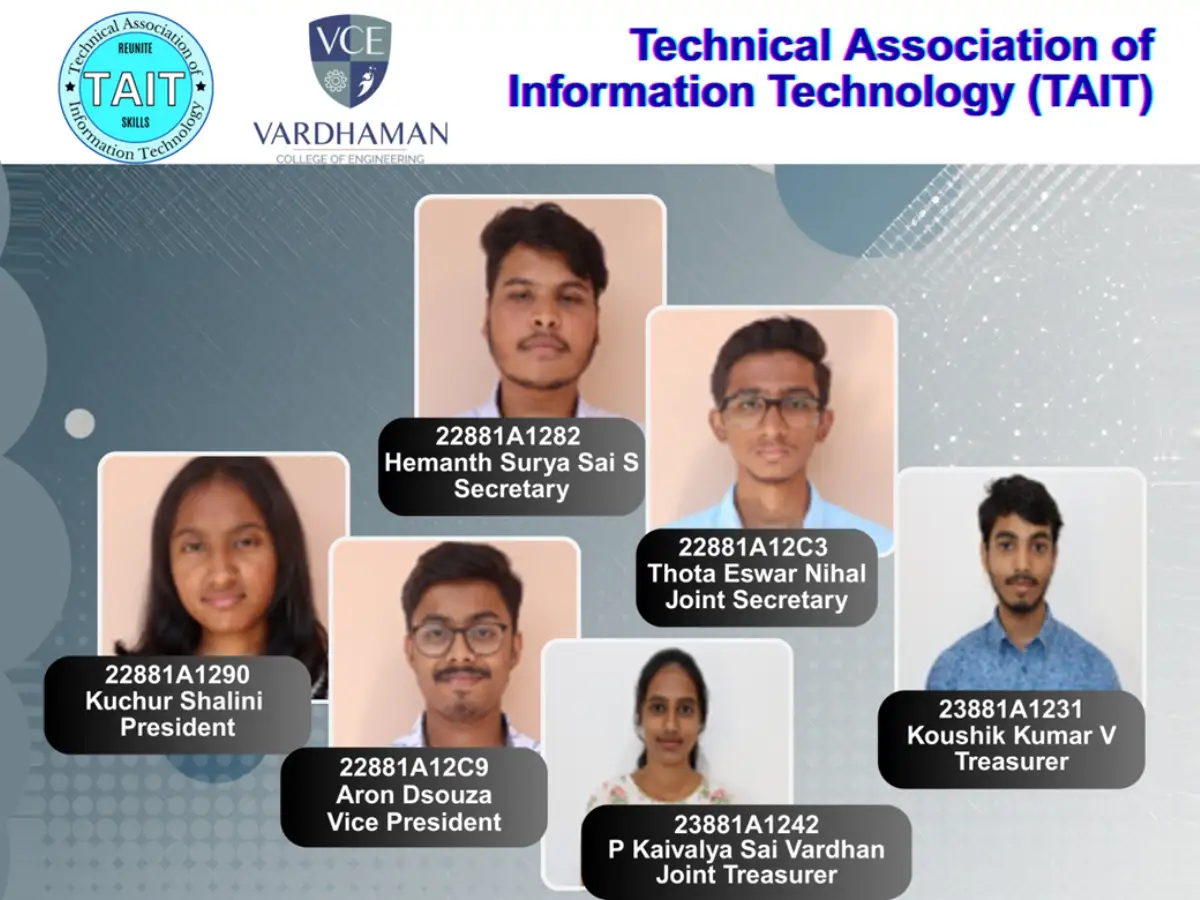
The Technical Association of Information Technology (TAIT), established in 2012 at Vardhaman College of Engineering, provides a platform for students to participate in technical and extracurricular activities that enhance academic learning. It promotes collaboration, innovation, leadership, and creativity among students from various departments and academic years.
TAIT is managed by a leadership team comprising a Chairman, Secretary, President, and Treasurer, ensuring smooth functioning of activities. The association focuses on interdisciplinary learning and holistic student development by strengthening both technical and soft skills.
TAIT operates through four specialized clubs:
The Association for Computing Machinery (ACM) is the world’s largest and most prestigious professional organization dedicated to advancing computing as a science and profession.ACM supports innovation, research, and education in computer science and related disciplines.